SANCTIONS COMPLIANCE | CANADA–MEXICO OPERATIONS | GOVERNANCE RISK
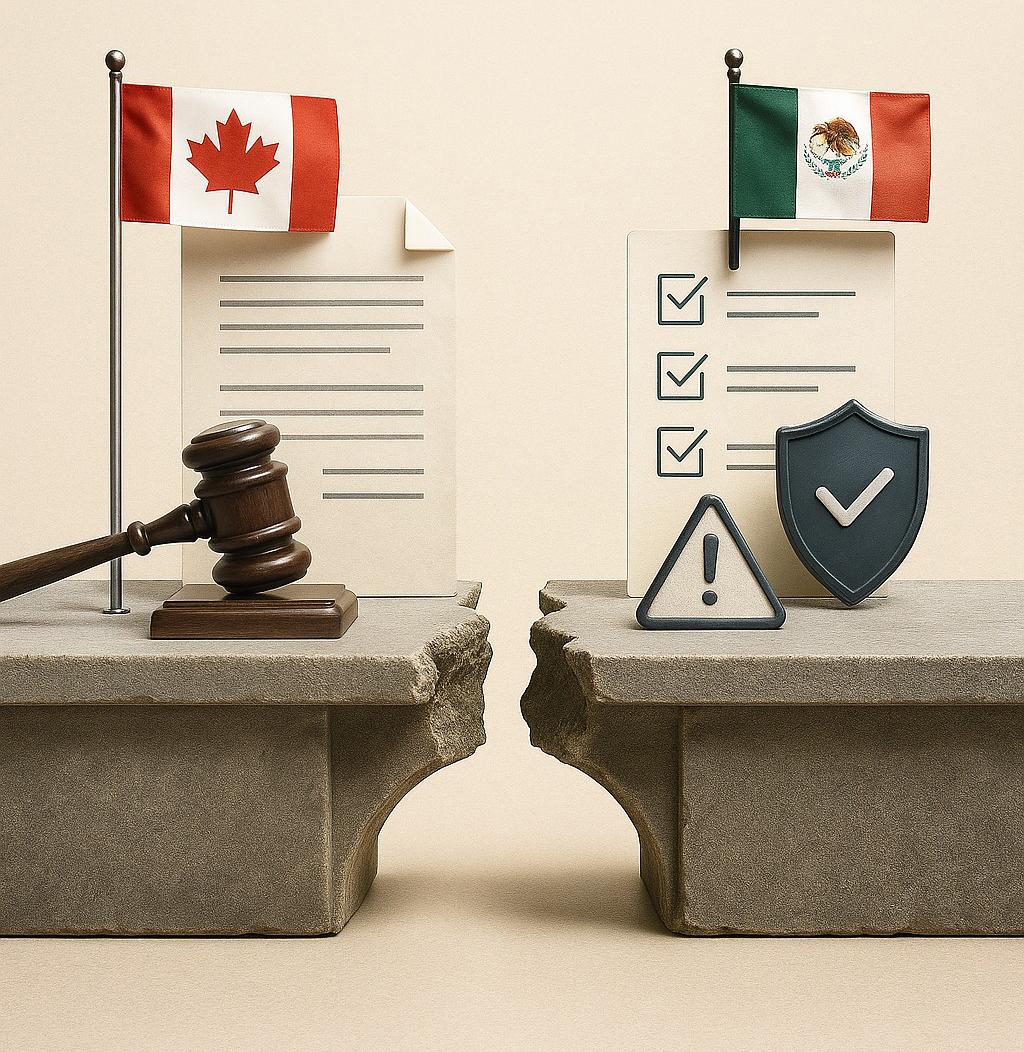
Executive point: Canadian companies often picture their Mexico operations as a natural extension of Canadian governance standards. The real risk is the silent disconnect—where unverified assumptions collide across both systems.
1. The silent disconnect
Canadian companies often picture their Mexico operations as a natural extension of their Canadian governance standards. The reality is more complex. Beneath the surface, the legal, cultural, and operational frameworks of both countries pull in different directions—creating a regulatory tension most organisations don’t see until it breaks. This silent disconnect, not Mexico itself, is where the real cross-border risk lives.
2. Canada’s sanctions expectations
Recent updates to Canada’s sanctions regime—including stricter guidelines, enhanced enforcement expectations, and deeper international coordination—reflect a clear trend: regulatory oversight is becoming more rigorous and far less tolerant of ambiguity. Global Affairs Canada (GAC), acting under the Special Economic Measures Act (SEMA), the Justice for Victims of Corrupt Foreign Officials Act (JVCFOA), and Canada’s autonomous sanctions framework, has issued increasingly precise expectations for how organisations must structure governance, risk assessment, due diligence, internal controls, and monitoring.
Official Canadian sources:
These documents describe the standards expected under Canadian law: robust due diligence, documented traceability, senior management oversight, third-party screening, continuous monitoring, and the ability to demonstrate—if audited—that risks have been identified, assessed, mitigated, and documented. None of this is optional. It is the compliance floor, not the ceiling.
For organisations with operations or supply chains in Mexico, one question becomes unavoidable:
What happens when two fundamentally different regulatory cultures must operate inside a single corporate structure—and both impose binding obligations?
3. A risk that rarely comes from bad faith, but from disconnect
Canadian companies operating in Mexico often believe their risk is under control because they:
- maintain formal policies,
- follow ESG/ASG and ethical guidelines,
- and rely on Canadian-based leadership to “oversee” foreign subsidiaries.
However, as GAC’s own guidance makes clear, policies alone are irrelevant if operational reality does not align with documented controls. That’s the blind spot: Canadian compliance expects structured implementation. Mexican operations move fast, adapt constantly, and often bypass controls to avoid disruption. Both sides assume the other is closing the gap—and neither is.
What counts as compliance in Canada can collapse in Mexico due to structural and cultural dynamics such as:
- decentralised, urgency-driven decision-making,
- incomplete vendor traceability,
- local intermediaries with undocumented leverage,
- technical information exchanged without formal safeguards,
- documentation that exists—but fails Canadian evidentiary or audit expectations.
From GAC’s perspective, these gaps reflect failures in the implementation of a sanctions compliance program, not mere operational quirks.
4. Is there a Mexican equivalent?
Mexico does not operate a sanctions regime structured like Canada’s Special Economic Measures Act (SEMA) or Justice for Victims of Corrupt Foreign Officials Act (JVCFOA), but it does have parallel enforcement frameworks that impose binding obligations for companies operating within its jurisdiction:
- List of Blocked Persons (UIF) — restrictions and asset freezing for local individuals and entities under suspicion of illicit activities.
- LFPIORPI — AML/CTF obligations for vulnerable activities, including the identification of beneficial owners and suspicious financial transactions.
- National Anti-Corruption System (SNA) — anti-corruption measures, integrity, and transparency for public and private entities.
However, Mexico’s approach differs fundamentally from Canada’s. Unlike Canada’s explicit sanctions enforcement (which directly targets designated individuals/entities linked to crimes such as terrorism, money laundering, and human rights abuses), Mexico’s regulatory focus is on preventing financial crimes and ensuring anti-corruption practices are followed at all levels, including for public officials and private companies.
In Canada, compliance is measured by traceability, documentation, and demonstrable oversight.
In Mexico, compliance is defined by operational execution, local risk culture, and direct relationships with authorities.
When companies fail to consciously bridge both systems, they silently expose themselves to regulatory risks in both countries.
5. The invisible gap: where real risks emerge
A sanctions compliance program that is strong on paper (Canada) can fail at the operational level (Mexico). Likewise, an efficient Mexican operation does not meet Canadian expectations for sanctions screening, beneficial ownership verification, export-control analysis, or escalation protocols.
This disconnect creates vulnerabilities such as:
- informal decisions that never reach Canadian oversight,
- third parties unscreened against Canadian or Mexican restricted lists,
- technical information shared without export-control evaluation,
- limited visibility over intermediaries and transaction chains,
- workarounds that bypass approval flows under pressure,
- governance structures that bear no resemblance to how decisions are actually made.
As GAC emphasises: the greatest sanctions risk is not lack of intention—it is the assumptions companies never verify.
6. A practical cross-border scenario
Imagine a Canadian parent company that has implemented a sanctions compliance program aligned with Global Affairs Canada’s guidance. On paper, the framework is complete: policies are approved, training has been delivered, and internal controls exist.
But in Mexico, a local manager under pressure relies on an intermediary to expedite a transaction. The customer’s ownership structure is not fully transparent, and the bank flags the payment. Further review reveals a connection to a blocked person—something that would have been caught earlier if Canadian expectations had truly reached the operational level.
From the perspective of Canadian headquarters, the company “had a program.” From the Mexican perspective, the program never reached the place where real decisions are made. This gap between intention and execution is where cross-border compliance quietly breaks down.
7. Regulatory Penalties: A Growing Risk
In recent years, Canada has strengthened its penalties for violations of sanctions and compliance regulations, particularly for those operating internationally. Under the Special Economic Measures Act (SEMA) and the Justice for Victims of Corrupt Foreign Officials Act (JVCFOA), penalties for non-compliance can reach up to CA$ 100,000 in fines and five years in prison — a warning sign for all Canadian companies involved in cross-border transactions, especially those dealing with regions like Mexico.
Furthermore, Canadian penalties now cover indirect transactions and third-party dealings, so it is no longer enough to rely on local compliance programs alone. Canadian law applies to your global operations, and non-compliance in Mexico can result in fines, sanctions, or even jail time for key company officers.
But it’s not only Canada that is tightening its grip. Mexico has also become more stringent in enforcing anti-money laundering (AML) and anti-corruption regulations. Recent reforms, such as updates to the Federal Law for the Prevention and Identification of Operations with Resources of Illicit Origin (LFPIORPI), have introduced stronger controls on financial activities and the tracking of beneficial owners.
Both countries are ramping up their enforcement. This regulatory push makes it critical for companies to align their governance structures and compliance programs **across borders**—before the penalties hit from both sides.
8. Conclusion
Operating across Canada and Mexico demands more than obeying two sets of laws. It requires understanding how both systems think, prioritise, document, and enforce—and how their untested assumptions collide in the middle.
This is precisely where my work is focused: at the operational junction where Canadian corporate requirements and Mexican realities diverge. That is where unmonitored risk accumulates, where sanctions exposure becomes real, and where the most critical cross-border interventions must occur.
Because in the Canada–Mexico regulatory bridge,
the true risk is never bad faith—it is the illusion of control.
Jorge Gutierrez
Foreign Legal Consultant
Cross-Border Corporate Governance & Compliance (Canada–Mexico)
Note: This article is provided for general informational purposes and does not constitute legal advice.