
The Mission Is Over.
Now Exposure Begins.
On what responsible organizations do — and what most don't — in the months that follow a commercial mission.
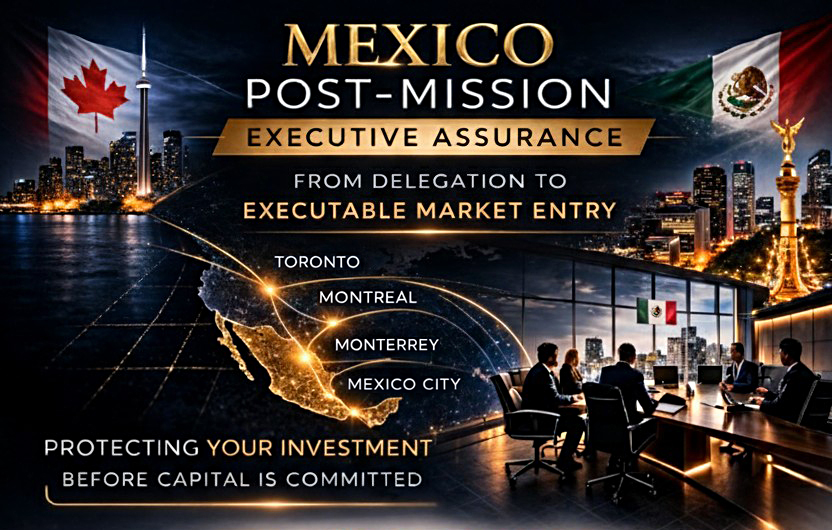
Commercial missions create visibility, access, and momentum.
They also create expectations.
Local partners assume progress. Internal teams push for action. Boards expect results.
What rarely exists at that moment is a disciplined execution framework.
Now is when decisions start carrying fiduciary weight.
Which contacts are viable partners? Which opportunities can actually be executed? Which structures protect the organization — and which expose it?
Most organizations underestimate this phase because the mission itself feels like progress.
It isn't.
It's reconnaissance.
What responsible organizations do next
They pause before committing.
They validate assumptions. They test structural viability. They map exposure. They align governance before capital moves.
Not because they are cautious — because they understand accountability remains at home.
Based on two decades of corporate law and governance experience in Mexico, operating within Canadian fiduciary frameworks, this is the moment where execution discipline matters most.
Not during the mission.
After it.
When enthusiasm begins to transform into commitments.
If advising an executive team returning from Mexico, these are the three immediate priorities:
-
Exposure Mapping Understand the real implications of each potential partnership, structure, or commitment.
-
Execution Architecture Define how entry would actually occur — legally, operationally, and financially.
-
Governance Alignment Ensure decisions made abroad can be defended under Canadian fiduciary expectations.
There are many ways to approach this phase.
What matters is not how you do it — but that you do it before commitments harden into obligations.
Organizations that skip this step often discover too late that momentum can be more dangerous than uncertainty.
Exposure is rarely created by action. It is created by action without structure.
The mission created opportunity.
What happens next determines whether that opportunity becomes execution — or exposure.
I operate at this intersection because it is where most cross-border initiatives succeed or fail.
Not in the meetings.
In the months that follow.
For organizations evaluating next steps after the Mexico mission, this is the decision window.
It is the phase where momentum turns into commitments — and commitments can become liabilities if exposure and structure have not been validated.
This phase requires architecture, not enthusiasm.
How you build that architecture is secondary. What matters is that it exists before capital, signatures, or operational dependency is introduced.
Executive implementation is not improvised. It is structured.
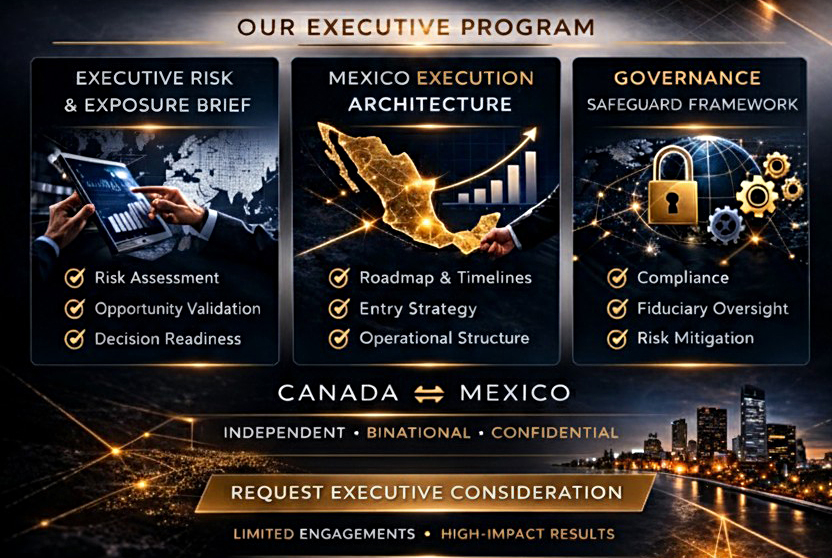
Request Executive Consideration
A short, structured discussion focused on exposure mapping, execution architecture, and governance alignment — before commitments harden into obligations.
Request a Confidential Executive Discussion Follow on LinkedIn ↗Confidential · Independent · Binational